

The focusing depth of an Nd: YAG laser machine is a critical parameter that significantly impacts its performance across various applications, from medical treatments to industrial manufacturing. As a leading supplier of Nd: YAG laser machines, understanding this concept is essential for both our technical team and our clients. In this blog, we'll delve into the intricacies of the focusing depth of an Nd: YAG laser machine, exploring its definition, influencing factors, and implications for different applications.

Understanding Focusing Depth
The focusing depth, also known as the depth of focus, refers to the range along the optical axis within which the laser beam remains acceptably focused. In simpler terms, it's the distance over which the laser can maintain a relatively small spot size and high intensity. A larger focusing depth means that the laser can effectively process materials at different depths without frequent refocusing, which is particularly advantageous in applications where the workpiece surface is uneven or the processing requires penetration to various depths.
Mathematically, the focusing depth (Δz) can be approximated by the formula:

Δz = ± 2λ / (π * (NA)^2)
Where λ is the wavelength of the laser light, and NA is the numerical aperture of the focusing lens. From this formula, we can see that the focusing depth is inversely proportional to the square of the numerical aperture and directly proportional to the wavelength.

Factors Influencing Focusing Depth
- Wavelength of the Laser: Nd: YAG lasers typically operate at wavelengths of 1064 nm (infrared) and 532 nm (green), with the 1064 nm wavelength being more commonly used due to its deeper penetration capabilities. According to the formula, a longer wavelength results in a larger focusing depth. This is why the 1064 nm Nd: YAG laser is often preferred for applications requiring deep penetration, such as laser welding and deep tissue treatment in medicine.
- Numerical Aperture (NA) of the Focusing Lens: The numerical aperture is a measure of the lens's ability to gather light and resolve fine details. A lens with a high NA can focus the laser beam to a smaller spot size but has a shallower focusing depth. Conversely, a lens with a low NA will have a larger focusing depth but a larger spot size. When selecting a focusing lens for an Nd: YAG laser machine, a balance must be struck between the desired spot size and the required focusing depth based on the specific application.
- Beam Quality: The quality of the laser beam, often characterized by the M^2 factor, also affects the focusing depth. A beam with a lower M^2 value is considered to have better beam quality, meaning it can be focused to a smaller spot size and has a longer focusing depth. Maintaining high beam quality is crucial for achieving precise and consistent results in laser processing.
Applications and Focusing Depth Requirements
- Medical Applications:
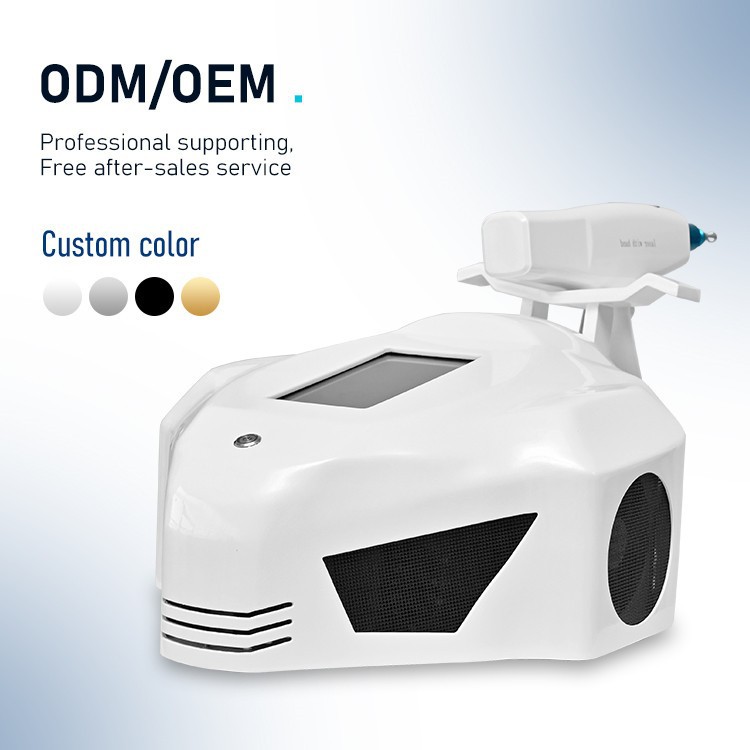
- Tattoo Removal: In tattoo removal, the Nd: YAG laser is used to break down the tattoo pigments into smaller particles that can be absorbed by the body's immune system. Different tattoo pigments absorb laser light at different wavelengths, with the 1064 nm wavelength being effective for darker pigments and the 532 nm wavelength for lighter pigments. The focusing depth needs to be adjusted to target the specific layers of the skin where the pigments are located. Our ND YAG Q Switch Tattoo Removal Machine is designed to provide adjustable focusing depths to ensure optimal treatment for different tattoo depths and colors.
- Pigment Removal: For the removal of skin pigments such as age spots and freckles, the Q Switch Laser Laser Pigenment Removal Machine uses the Nd: YAG laser to selectively target and destroy the pigmented cells. A precise focusing depth is required to ensure that the laser energy is delivered to the pigmented cells without damaging the surrounding healthy tissue.
- Industrial Applications:
- Laser Welding: In laser welding, the focusing depth determines the thickness of the materials that can be welded. A larger focusing depth allows for the welding of thicker materials or materials with uneven surfaces. The Nd: YAG laser's ability to provide a high - energy density within the focusing depth makes it suitable for welding a wide range of metals, including stainless steel, aluminum, and titanium.
- Laser Marking: Laser marking involves using the laser to create permanent marks on the surface of materials. A shallow focusing depth is often preferred for high - resolution marking, as it allows for a smaller spot size and more precise control of the marking process. However, in some cases where the material surface is not perfectly flat, a slightly larger focusing depth may be required to ensure consistent marking quality.
Importance of Controlling Focusing Depth
Controlling the focusing depth of an Nd: YAG laser machine is crucial for achieving high - quality results in various applications. In medical treatments, an incorrect focusing depth can lead to ineffective treatment or damage to healthy tissue. In industrial manufacturing, it can result in poor weld quality, inaccurate markings, or inefficient material processing.
Our company offers Nd: YAG laser machines with advanced focusing systems that allow for precise control of the focusing depth. These systems may include adjustable lenses, motorized focusing mechanisms, and real - time monitoring and feedback to ensure that the laser beam remains focused at the desired depth throughout the processing.
How to Optimize Focusing Depth for Your Application
- Understand Your Application Requirements: Before selecting an Nd: YAG laser machine, it's essential to understand the specific requirements of your application, including the material type, thickness, and the desired processing depth. This will help you determine the appropriate wavelength, numerical aperture, and beam quality for your needs.
- Choose the Right Focusing Lens: Based on your application requirements, select a focusing lens with the appropriate numerical aperture to achieve the desired balance between spot size and focusing depth. Our technical support team can assist you in selecting the most suitable lens for your specific application.
- Calibrate and Adjust the Focusing System: Regularly calibrate and adjust the focusing system of your Nd: YAG laser machine to ensure accurate and consistent focusing depth. This may involve using alignment tools and following the manufacturer's recommended calibration procedures.
Conclusion
The focusing depth of an Nd: YAG laser machine is a complex yet crucial parameter that significantly impacts its performance in various applications. As a supplier of Nd: YAG laser machines, we are committed to providing our clients with high - quality products and technical support to help them optimize the focusing depth for their specific needs. Whether you are in the medical field or industrial manufacturing, understanding and controlling the focusing depth of your Nd: YAG laser machine is essential for achieving the best results.
If you are interested in learning more about our Nd: YAG laser machines or have any questions regarding focusing depth and its applications, please don't hesitate to contact us. Our team of experts is ready to assist you in finding the perfect solution for your business.
References
- "Laser Physics" by W. T. Silfvast
- "Medical Lasers and Their Applications" by A. Katzir
- "Industrial Laser Applications" by P. Bäuerle